Daily Tip
"NEVER FOCUS ON A TEAM MATES' MISTAKES. IF THERE'S SOMETHING CONSTRUCTIVE (NOT CONDESCENDING) TO POINT OUT, DO IT IN A FRIENDLY WAY."
Competitive Match Tracker
Tracker Origin & Support
This tracking system was originally designed by Reddit user LeCorbuisoverrated. While the original sheet has been discontinued, we continue to maintain and update the template configuration with new maps, game modes, and heroes as they join the roster.
Get Your Tracker Sheet
Choose a template type below. To start using one, open the link, click File > Make a copy, and save it to your Google Drive.
OpenQ Template
Track standard open queue formats with open role flexibility.
Tank Tracker
Dedicated metrics focusing on tank gameplay mechanics.
Damage Tracker
Optimize DPS stats, hero selections, and map pressure.
Support Tracker
Detailed logging for healing, utility support, and survival rates.
The spreadsheet uses the legacy numerical Skill Rating (SR) values. Use this reference map to translate your current division tiers into mathematical equivalents.
Setup Instructions
Configure Time Zone
In your copied Google Sheet, navigate to File > Settings and select your local Time Zone. Do not modify other regional spreadsheet settings to avoid math errors.
Initialize Placement SR
Once your competitive tier placement maps finish, populate your baseline rating into the starting SR cell to establish your stats history baseline.
Log Match History
After each game session, fill in the metrics (Map, Hero choices, Team average rating, and notes). Cell inputs highlighted in Blue require manual inputs; Light Blue cells contain automated formulas.
Input Sheet URL
Copy the exact web URL of your spreadsheet into the cell next to the "Next Match" top bar button. This links the custom macros correctly and lets the link cleanly disappear.
Quick Abbreviations Key
Refer to this shorthand reference layout to log maps, objectives, and heroes accurately.

Sheet Architecture
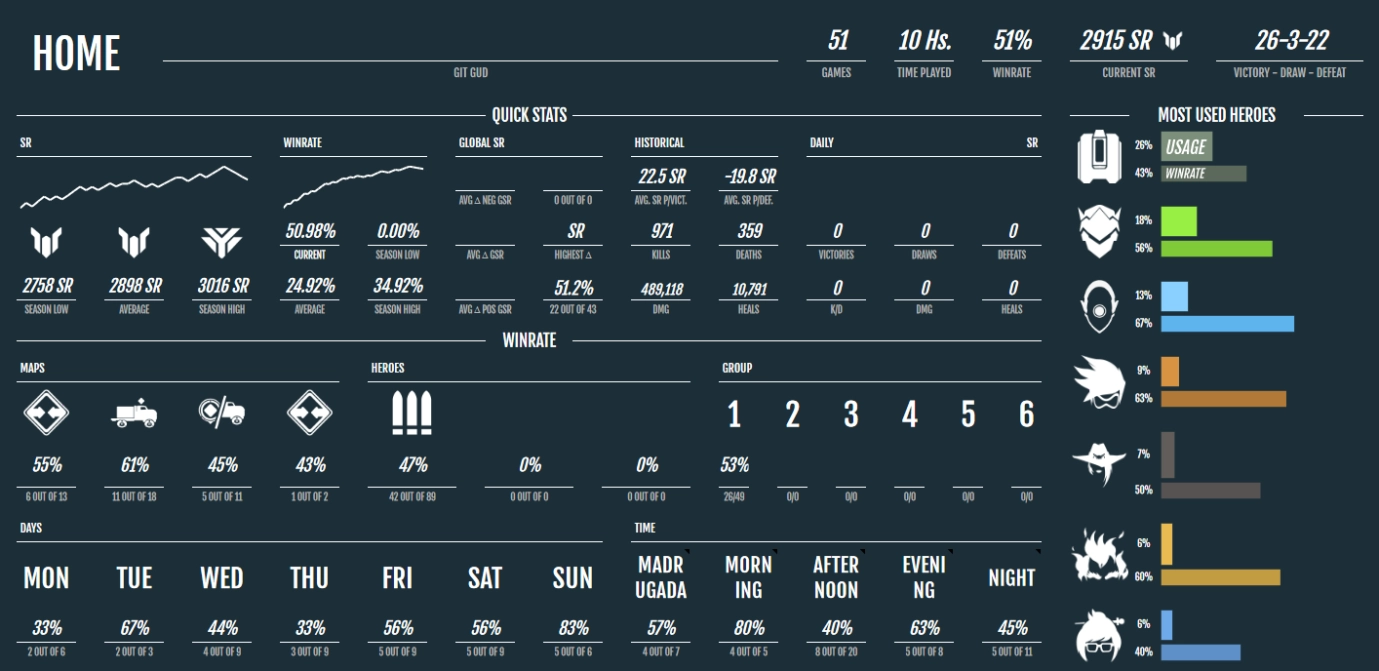
Home Dashboard
Presents a unified overview of all competitive ranks, season wins/losses, role distributions, and key KPIs.
Maps Performance
Correlates specific stages with your win rates, tracking which objectives fit your roster's pools.
Mates & Groups
Assesses team performance variables based on who you group up with in your matches.
SR/WR Progression
A visual progress line tracking rating changes over time to monitor consistency.
Hero Database
Highlights average SR swings (won/lost) per character, general win ratios, and role efficiency.
Timeline Analytics
Find patterns detailing when you secure wins by cross-referencing day schedules and peak playtimes.
Advanced Assets
Dynamic background assets syncing sheets to a global schema to auto-populate future game content updates.
SR Swing Dynamics
Evaluates point fluctuations after matches to map performance swings against expectations.
Frequently Asked Questions
Q: Can I request additional tips or advice matrices?
A: Currently, the advice templates remain static, but custom advice sheets can be easily written straight inside your copied spreadsheet file.
Q: Where are Overwatch screenshots stored by default?
A: By default, the client writes files to "Documents\Overwatch\ScreenShots\Overwatch". Check your in-game keybind layouts for the screenshot shortcut.
Q: Can I use this file inside Excel, Calc, or Apple Numbers?
A: No. Many core metrics rely on Google Sheets exclusive dynamic functions (like QUERY and custom imports) and will break on other engines.
Q: What is the naming scheme behind the version tags?
A: Following the original creator's convention of naming versions after geography, we tag updates using high peak names (Aconcagua, Bonete Chico, Paramillo, etc.).
Q: Is there an easier way? Doing this manually feels like a job!
A: Until public competitive match APIs are open, manual data entry is necessary. Tools like Overbuff track stats automatically, but cannot correlate personal variables like schedule, stack teammates, or match notes.